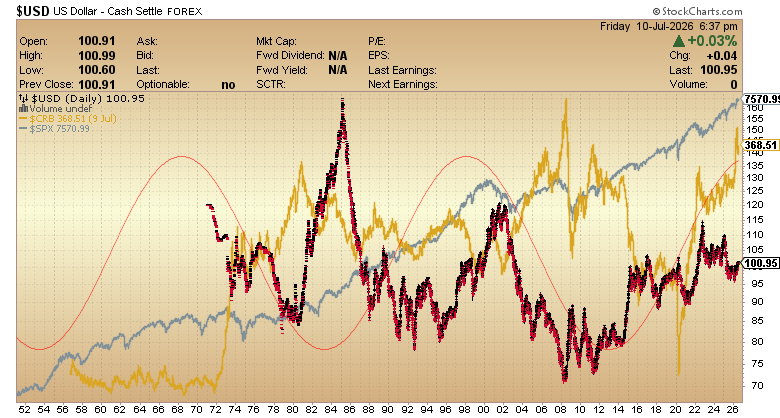
A colleague asked some good questions about a dollar cycle/commodities chart I shared last week (first chart below). The chart showed commodities (gold line) rising over the last five years while the dollar (black and red line) has been rising and stocks (gray line) have also been rising. This is abnormal, as historically the broad commodity cycle tends to be inversely related to stocks and dollar strength. This aberration could be explained by the enormity of passive investing, indexation, and intense actions to keep stocks afloat by the powers that be in an effort to stave off a very messy reset. (Must get control mechanisms in place before that happens.) A rising stock market also attracts foreign flows, which boosts the dollar—particularly when the rest of the world is less attractive. So, it’s possible that the stock market and dollar gains in recent years are less rational, organic and “free market”-based than is typical.
Commodities rising despite a stronger dollar and a rising stock market could be viewed in a number of ways. Still cheap enough because supply is short. Still cheap enough to be a better alternative to stocks. Still cheap enough because investors don’t trust governments and central banks to control the outcome without creating inflation and destroying their currencies. Those factors continue to attract buyers.
When we look at the Reuters/Jefferies Commodity Index relative to the S&P 500 below, we can see that commodities are still very cheap on a relative basis despite their rise. In other words, plenty of room to run as these cycles (thin red line representing long-term dollar cycles) continue to play out. Dollar and stocks eventually lower, natural resources higher. Russia, Iran, Venezuela, and most of the other geopolitical situations playing out today have everything to do with these trends kicking in and running for a good length of time.
What do we do about it? Exactly what we’re already doing. Jump in the car most suited for the race at hand and buckle up.