
I don’t feel our clients hire us to repeat industry talking points or to project perpetual sunshine, because since forming Cadence, we haven’t. Don’t get me wrong, we are fun-loving, positive people at the office, but we have no interest in ignoring important details that could impact our clients’ lives. Being too myopic in view or playing ostrich in the sand just to keep comfortable helps no one. I do think our clients hire us to help them evaluate the financial world, investment landscape, and achieve and maintain financial freedom – regardless of how unique or seemingly unorthodox that process can feel at times, or of the conclusions that we might draw. I want to thank every one of our clients for allowing us to serve them this way and for being open-minded to entertaining different perspectives on the financial world and the broader issues that can act on it. I truly believe this dispassionate, agnostic approach when it comes to planning, will make all the difference. Thank you.
Fuzzy Big Picture
In assessing what’s going on around us, we’re limited to observing facts, actions, and outcomes. Like in a criminal investigation, we rarely know for sure the intentions of the key players, but sometimes in understanding incentive structures and previous behavioral patterns, we can establish a likely motive or desired outcome. The goal is to assemble a puzzle that presents as clearly as possible a picture of what’s playing out in front of us. Sometimes it’s fuzzier than we’d like. Other times there are two completely different picture possibilities given different scenarios and assumptions. Counterintuitively, it should never be absolutely clear in a complex world – that’s almost a sure sign that we’ve let bias creep into the process. You might ask why this matters if we can’t do much to change the unfolding of events anyway? Our feeling is that the more we know about what’s going on and the possible outcomes, the better we can prepare. It’s all in the preparation. Tech stocks are positioned for giant losses – you can choose to avoid them. Commodities are set up to be in very short supply – you can make sure to buy the ones you need to live, invest in others, and plan for the knock-on effects. The education system is providing much less return on investment to students as traditional jobs become harder to come by – you can rethink everything relating to how to best prepare your child for the world, and how to best help them bring value to that world. Maybe it’s not spending $250,000 and wasting four of their most energetic years of life. Maybe. It depends on much, but understanding these broad directional trends can be hugely impactful.
The fuzzy puzzle picture we see in front of us at the moment is this: The western world—mainly Europe and the U.S.—is very late stage. Governments have grown past their useful sizes in terms of scope, scale, and spending levels. This is entirely predictable as any body that has the ability to tax, spend, and write the rules will only get bigger – it will never self-limit. In the U.S., we now spend over $1 Trillion per year on interest on our roughly $40 Trillion of public debt. If interest rates rise, that interest expense will rise, necessitating more borrowing to cover it, which reinforces both higher interest rates and more future borrowing. It’s a vicious cycle for which the only long-term fix is either a debt default, a debt forgiveness, or a restructuring event. You can’t grow your way out of this – despite what the profligate spenders in Washington will tell you. An important factor in weighing these potential outcomes is the level of unity amongst Western nations. If strong, the odds of a coordinated debt jubilee are better as they would all be in it together, thus protecting their respective currencies from rapid deterioration. If weak, this increases the risk to any one nation for a currency crisis and traditional default and increases the desperation for real assets in preparation. Those nations with the most robust inventory of gold, energy, and other natural resources would likely be in the strongest position to carry on after some sort of “debt reset”. This is one of those scenarios where we could just stick our heads in the sand and tell you, “Everything will be fine, we’re all in it together”, but that reflects inaction and complacency – we prefer preparation through action. It could make all the difference. This point in history, although it feels to us like one ordinary day after another, isn’t insignificant.
Despite actions being taken in multiple theaters to prepare for the possibility, shorter term, nobody wants a debt default. A routine recession and stock market decline would be more manageable. So, getting interest rates down across the duration curve (long and short-term rates) would alleviate some of the borrowing burden for both government and the average Joe. It wouldn’t be a long-term fix, but it would buy more time. The problem of course, is how to get longer-term market rates down when inflation is picking up across the board. We are at that point in the cycle where commodity supply constraints (due to prices being low for too long) are pushing prices higher despite the government’s (I include the Federal Reserve in this) efforts to keep inflation lower. The market simply doesn’t believe the FED has control anymore and sees every softening of policy as inflationary. The new Fed chair Kevin Warsh was likely chosen to change this thinking and give markets renewed confidence that the FED somehow has the ability to control what happens to commodity prices when they are in short supply. At the end of the day, we still feel there is a good chance that the monetary authorities realize the only way to keep interest rates under control in the face of a secular bull market in natural resources, is to allow the stock market to fall and a recession to play out. In other words, they need to stop kicking the can if they want to avoid having rising rates jam up the machinery underpinning the entirety of the financial system – debt and leverage. A weak economy leads to low interest rates. That’s the only natural relationship that holds over time. Anything else is synthetic and unsustainable.
Finally, it’s worth noting that there is plenty of embedded risk within the financial system at the moment as a result of the 16-year expansion in stocks and debt instruments, and the malinvestment accompanying it. Whether losses on bonds that the banks are still holding, or private equity and credit investments that are both less liquid and solvent than initially thought, as Jamie Dimon recently put it, “When you see one cockroach, there are probably more”. The financial system at the moment is quite literally a leaning tower of rot that fears a stiff wind. All of market history and the nature of cycles suggests that wind will hit the forecast at some point. The interesting thing to ponder however, is how and who will be to blame when the structure falls. The Russia/Ukraine conflict was used as a scapegoat for the inflation that had been ramping up for more than a year prior. In fact, the onset of the conflict in early 2022 roughly marked the peak as inflation dropped throughout the year and ultimately bottomed in early 2023. Will this Iran conflict be used to scapegoat inflationary pressures that were already present beforehand? Will the coming stock market and economic decline and financial system fallout be blamed on the conflict as well, rather than the parties more directly responsible for creating and perpetuating it? We will see, but throughout history, those in charge have always looked to summon up enemies to keep the tomatoes from being hurled at them. There were major fractures within the financial system in late 2019 – Covid distracted people from the cause. Double digit inflation into 2022 – Ukraine distracted people from the cause. Today, we have inflation ramping, private credit issues, commercial and residential real estate issues, economic issues – Iran and Russia stand ready to distract and take some of the blame. None of this speaks to intention, just observable actions and patterns and a blurry puzzle picture.
Established Trends
I’ve already gone on too long, so I’ll try to accelerate the major points from here on. Commodity and natural resources across the board have started rising in price after falling in price for years. This reflects a proper cycle. The illustration below summarizes what drives an oil market cycle, which holds true for all commodities. The gist is that if prices are too low for too long, there’s no profit incentive to make more of it, supply eventually falls below demand, and prices rise until adequate profit can be made and supply replenished. The system always overshoots due to time lags which is what creates the up and down nature of cycles. In short, the low prices of past years and dramatic underinvestment in new supply have set the stage for higher commodity and natural resource prices going forward.

By contrast, although stocks are still in an uptrend, they are long overdue to initiate a corrective downtrend. By many valuation metrics, stock markets are as much as 200% overpriced, which means a drop of -67% would get them back to what we’d consider “fair price”. Not cheap, but fair price. To get cheap means a bigger drop is required. As discussed earlier, the stock market being this overpriced for this long has created a set of problems that need to be dealt with. There is no easy fix. Asset prices must come down. To stay high means more inflation, less affordability, and a widening wealth gap—all of which are bad for society.
A Standard Pause in Trend – Shakeout
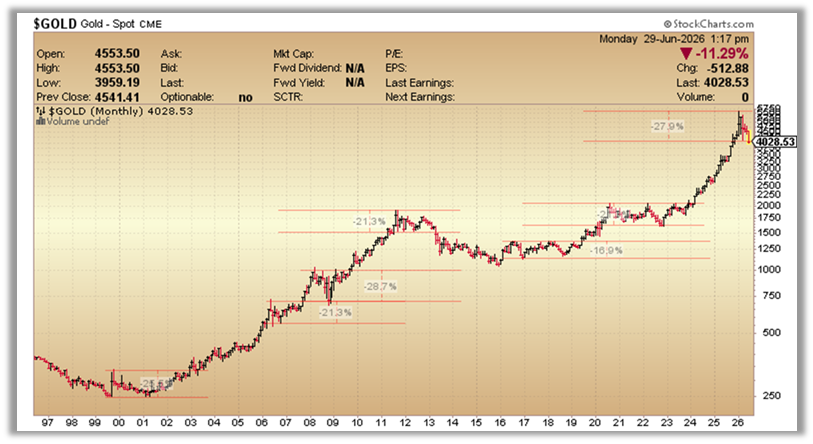
Last year, precious and base metals blasted higher and left little doubt that they had initiated their long-term move higher. Commodity markets are significantly smaller than the broader stock and bond markets, so large moves like this hint toward large capital inflows. That’s really important context in evaluating the pullback in prices since February since secular bull markets always experience pullbacks along the way that serve to shake out weak retail hands and give strong institutional hands more attractive buy points. Whether orchestrated or not (and many make a strong case for this being orchestrated) this phenomenon is reinforced by the fact that most small retail investors buy near the top after they’re thoroughly convinced of the upward direction, setting them up to lose more when the price inevitably corrects lower, panic, and sell out. Because most, larger, institutional investors buy earlier in trends, they are much calmer and better equipped to buy those shares from panicked retail investors after a meaningful price drop. It’s our opinion that this pullback in metals prices since essentially the onset of the Iran conflict in February is part of the normal corrective process facilitating the transfer of share ownership from retail to institutional hands. The goal of course is not to be one of these unsuspecting retail investors. The chart below shows the current pullback in gold within the context of prior gold bull market pullbacks – Relatively normal, and just about the full extent of the price reductions we’ve seen in the past. Buyers take note – and this same situation applies to most metals and miners.
Energy
Energy prices and the companies that deal in them didn’t have a great 2025 like metals did. Rather, they had a much better period of performance from 2021 through 2023. For an investor who finds the whole natural resources space undervalued and attractive for the reasons we stated above relating to underinvestment and supply shortages, this is a good thing. The fact that one can invest in a variety of natural resources sectors without them all moving in the same direction at the same time is actually what we want. This achieves diversification and reduces portfolio volatility without sacrificing longer-term performance potential. The energy sector makes up about 3-4% of the S&P 500 currently compared to a peak of roughly 16% in 2008. Given that the world as we know it literally comes to a grinding halt without adequate energy, this strikes us as far too low. What the Iran conflict could still teach us in the weeks and months ahead is that we aren’t just taking energy availability for granted, but also the availability of most other commodities we very much depend on throughout our daily routines.
A Word on Treasuries
The consensus on government bonds is that rising inflation will push interest rates up, which in turn will cause bond prices to fall. This is an entirely reasonable view. We’ve gone back and forth arguing both sides of various scenarios in an attempt to understand the most likely outcome for government bonds going forward. Our current thinking is that although we will probably have big issues farther down the road for the reasons we started this letter discussing, in the next few months and quarters, we feel much more positively about U.S. Government bonds. First, they have already come down in price significantly from their highs in late 2020 as interest rates have risen, and have stabilized since late 2022. Sideways trends are much less dangerous than long downward ones. At these levels, relative to stocks, they are extremely attractive when looking at the standard historical relationship between the two. Basically, with interest on government bonds at ~4.5%, and an average dividend yield on the S&P 500 of ~1%, once the stock market stops going up and investors are no longer confident in the capital appreciation component of their return, there is no comparison – bonds are better. Additionally, when we factor in total returns from a stock market making its way back to “normal” valuations over time – say a 12-year period – bonds at a 4.5% yield do about 4.5% better annually than a stock market that returns roughly zero. That’s not nothing – 4.5% better every year for 12 years is real wealth.
Second, if events lead to a recession and stock market pullback, that would likely be disinflationary causing interest rates to fall and bond prices to rise. As we mentioned earlier, this could well be the goal of monetary authorities as it’s the only surefire way to get longer duration interest rates down. Finally, government bonds serve as a diversifier within the portfolio to help manage risk along the way. Importantly, it is a diversifier that we feel good about over the near to intermediate term rather than one whose purpose is solely for diversification.
Conclusion
The world is dizzyingly complex, while at the same time being very late-stage in terms of its economic and market trajectory. We should expect some chaos as a result. The option isn’t to exit or to “check out” from the system as, like it or not, we’re a part of it. Pulling money from the markets requires that we put it somewhere – a bank account for example. Well, bank accounts are part of the financial system and possess their own set of risks ranging from inflation risk (which currently means a guaranteed loss of 4-8% depending on whose definition of inflation we’re using), to FDIC solvency, to the concept of bank bail-ins in the event of banking failures. The point is that if we are to participate in the world around us, we need to figure out how to safely and responsibly operate within it. This isn’t to say we shouldn’t advocate for things that create more individual financial autonomy and freedom and speak out or resist things that don’t, but in the meantime, the show must go on. Our thoughts are that the best way to position oneself in the months and years ahead is to avoid any significant exposure to the assets that are flying too close to the sun and position your portfolio in those assets that have very real potential to garner more attention and attract more capital over time, as a result of cheap prices, neglect, and the collective realization that we’ve all been focused on the wrong things over the last 10 to 15 years. There will be periods of time when confident buyers hope to take advantage of weary sellers – like now – but we get to decide which of those players we choose to be.
Finally, for those feeling as though they’re safe in the stock market because the wealthy have an interest in keeping it propped up, I’ll say this…The richest people in the world know that markets don’t go up forever. Once they feel there’s a better opportunity elsewhere, they’ll be among the first to take advantage of it. If that better opportunity exists in smaller markets that can’t absorb capital flows too quickly, then the process of reallocating capital needs to be stretched out over time, ideally with some big pullbacks along the way to make room for further purchases. What we’re currently experiencing is likely exactly this. And when the previously expensive stocks they once owned become cheaper? They buy them back from investors who overstayed their welcome and did more hoping than thinking. Again, we get to choose which player we want to be.
Editor’s Note: This article was originally published in the July 2026 edition of our Cadence Clips newsletter.
Important Disclosures
This blog is provided for informational purposes and is not to be considered investment advice or a solicitation to buy or sell securities. Cadence Wealth Management, LLC, a registered investment advisor, may only provide advice after entering into an advisory agreement and obtaining all relevant information from a client. The investment strategies mentioned here may not be suitable for everyone. Each investor needs to review an investment strategy for his or her own particular situation before making any investment decision.
Past performance is not indicative of future results. It is not possible to invest directly in an index. Index performance does not reflect charges and expenses and is not based on actual advisory client assets. Index performance does include the reinvestment of dividends and other distributions
The views expressed in the referenced materials are subject to change based on market and other conditions. These documents may contain certain statements that may be deemed forward‐looking statements. Please note that any such statements are not guarantees of any future performance and actual results or developments may differ materially from those projected. Any projections, market outlooks, or estimates are based upon certain assumptions and should not be construed as indicative of actual events that will occur. Data contained herein from third party providers is obtained from what are considered reliable sources. However, its accuracy, completeness or reliability cannot be guaranteed.
Examples provided are for illustrative purposes only and not intended to be reflective of results you can expect to achieve.