
The continued restricted movement of oil tankers through the Straight of Hormuz has reminded many of us just how essential oil has become to not just our economy, but to our very way of life. Don’t get me wrong, crude oil is dirty. Getting crude oil on your skin causes immediate irritation and can lead to chemical burns, rashes, and absorption of toxic chemicals. Burning unrefined crude oil creates thick black smoke, heavy soot, and toxic gases like sulfur dioxide and carbon monoxide. Even when refined, burning it causes byproducts that aren’t safe to breathe in at quantity.
Moving away from using oil as a fuel source is understandable, and cleaner forms of energy are obviously appealing.
And yet.
I do not say this with admiration for crude oil, but instead with an acknowledgement of just how incredibly versatile it is, and how incredibly widely-used it has become. Consider many of the uses of crude oil. For starters, there are the major transportation fuels:
- Gasoline (Petrol): The largest volume product, used primarily to power cars and light trucks.
- Diesel Fuel: A heavier fuel used for large trucks, buses, trains, and farm equipment.
- Jet Fuel: A specialized kerosene-grade fuel used for commercial and military aircraft.
Then, there are the heating fuels:
- Heating Oil: Used for residential and commercial space heating.
- Heavy Fuel Oil: Residual oil used in power plants, large ships, and industrial boilers.
- Liquefied Petroleum Gases (LPG): Gases like propane and butane used for home heating, cooking, and portable stoves.
After that, we find non-fuel products that are still very, well, oily:
- Asphalt: Heavy residues used to pave roads and for roofing sealants.
- Lubricants: Oils and greases used to reduce friction in engines and machinery.
All of those crude oil products at least resemble crude oil, if you can picture asphalt as crude in a solid form. However, what ELSE we create from crude oil after those really start to boggle the mind. Additional non-fuel products include:
- Paraffin: Used to make candles, crayons, waxes to keep fruit fresh, used in some chocolates, used to make cheese rinds, and used as a base for chewing gum.
- Thermoplastics: Used to make Teflon, vinyl and nylon.
- Phenol: Used in hair dyes, sunscreen, and even medications like aspirin and Tylenol.
- Refinery Gases: Used to make anesthetics like Bactine, and polypropylene used to make Tupperware.
- Petroleum Jelly: Used to make Vaseline, of course, but also as the base for lip balms and moisturizers.
Heating crude oil to different temperatures releases the various byproducts used to make all of these items and more: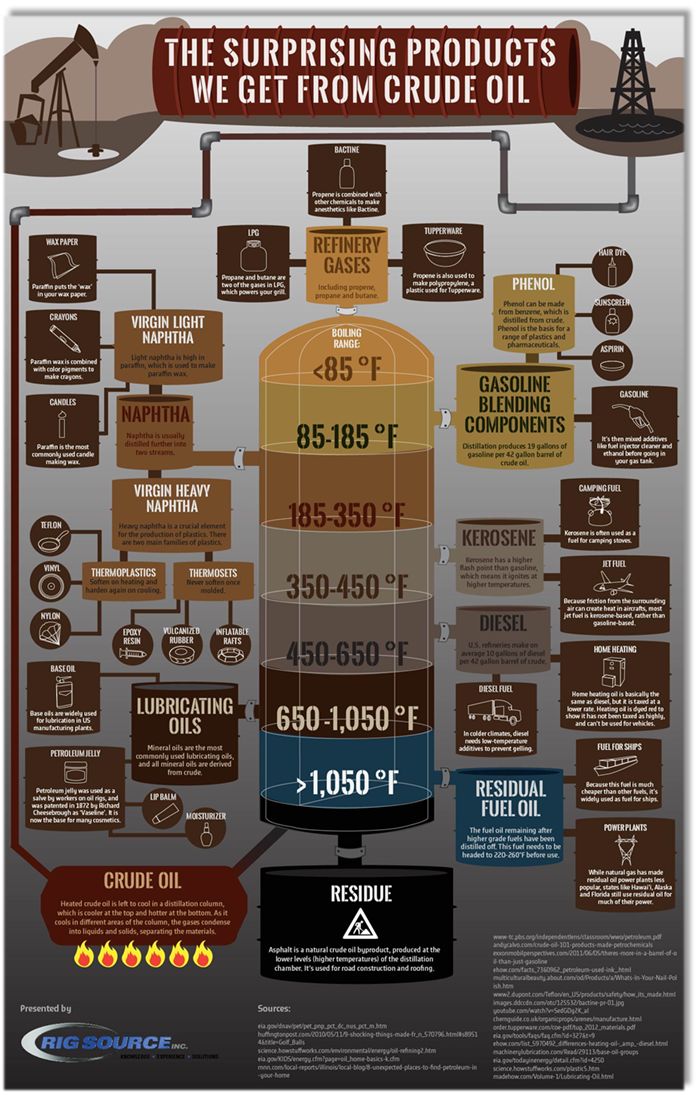
As is well known, and really easy to see when looking at the visual, there is no quick and easy way to move away from needing crude oil products. Even were we to make a giant and sudden move toward more renewable energy sources, we would still depend upon most of the rest of what we get from crude oil. Wind turbines aren’t also making asphalt and Tylenol. That is not to say substitutes do not currently exist, nor that there aren’t existing initiatives to further reduce our dependence on crude oil products. For example, On April 22, 2025, the U.S. Department of Health and Human Services and the Food and Drug Administration announced a national initiative to phase out petroleum-based food dyes (certified color additives) from the American food supply.
As it is, moving away from using oil and gas isn’t easy, because no substitute has yet been found that is as energy dense as crude oil. Even electric cars have to be plugged into a grid to recharge, and most of that grid is still powered by burning fossil fuels. Renewable energy accounted for about 24% of total utility-scale electricity generation in the United States in 2025, according to data from the U.S. Energy Information Administration. It will be a while before crude oil is completely replaced in all its uses, which is why it remains a viable area in which to invest.
Oil as an Investment
Real asset narratives broadly, and crude oil narratives more narrowly, influence investor behavior by shaping expectations about prices, risks, and future demand. Narratives such as oil scarcity, energy independence, or the transition to renewables can drive investors toward or away from particular sectors and assets. These narratives can also create herding and momentum, causing valuations to move ahead of underlying fundamentals. Investors may mistake temporary changes in energy prices or supply for permanent structural trends. Complicating that, there are competing narratives on how and for how long the current conflict in and around Iran will affect crude oil supply and prices.
A useful way to analyze crude oil investments is to separate the narrative from the underlying data.
For example:
Narrative: “The world is moving rapidly away from oil.”
Then ask:
- What is actually happening to global oil demand?
- How much production capacity is being added or removed?
- What are oil inventories doing?
- Is the move cyclical or structural?
Answering these one at a time yields:
- What is actually happening to global oil demand?
Demand is still enormous. The world consumed roughly 105 million barrels per day in 2025. OPEC still expects demand to grow over the longer term, reaching about 113 million barrels per day by 2030. The growth rate may be falling compared to past decades, but it is not reversing.
- How much production capacity is being added or removed?
According to the International Energy Agency, new crude capacity is still being added, but the additions are increasingly being offset by geopolitical outages, mature-field declines, and project cancellations/deferments. Its August 2026 outlook has global oil supply falling by about 4.3 million barrels per day in 2026, to roughly 102 million barrels per day. But that is largely a loss of operating production, not permanent destruction of productive capacity. The IEA expects supply to rebound by 8.3 mb/d in 2027 if disrupted production and transport routes normalize.
- What are oil inventories doing?
Global oil reserves have been falling rapidly since the Gulf/Hormuz disruption began, and those lowering reserves have continued despite weaker demand. Normally, if demand is weakening, inventories should be building. That tells us that the current supply disruption has been much larger than the demand reduction. Oil inventories are essentially the shock absorber of the oil market. When inventories are high and there is a supply disruption, you can draw from reserves and prices at the pump do not have to rise dramatically. However, when inventories are low and there is a supply disruption, oil prices have to rise enough to further reduce the demand for oil or to attract additional supply, which is very hard to attract at the moment. The U.S. Strategic Petroleum Reserve has fallen to roughly 290 million barrels, near levels last seen in the early 1980s, so we are in the latter situation where the strategic reserve is less and less able to keep oil prices down.
- Is the move cyclical or structural?
The oil market is undergoing a structural shift.
Transportation is becoming less oil-intensive. EV penetration, particularly in China, is reducing gasoline demand. High fuel prices are accelerating that substitution. Reuters reports that the current energy shock is already pushing more consumers in China and Europe toward EVs.
But oil isn’t just transportation fuel, as I mentioned early on.
Petrochemicals are becoming increasingly important. The IEA’s February outlook said petrochemical feedstocks would account for more than half of global oil-demand growth in 2026, compared with only about one-third in 2025. That means the net effect of lowered gasoline demand but higher petrochemical demand will still see a world continuing to demand a very high number of crude oil products, and possibly an increasing demand despite less gasoline consumption.
Adding to all of this is how the price of oil today compares to the price of financial assets like the S&P 500 index, and where that relationship stands relative to the past.
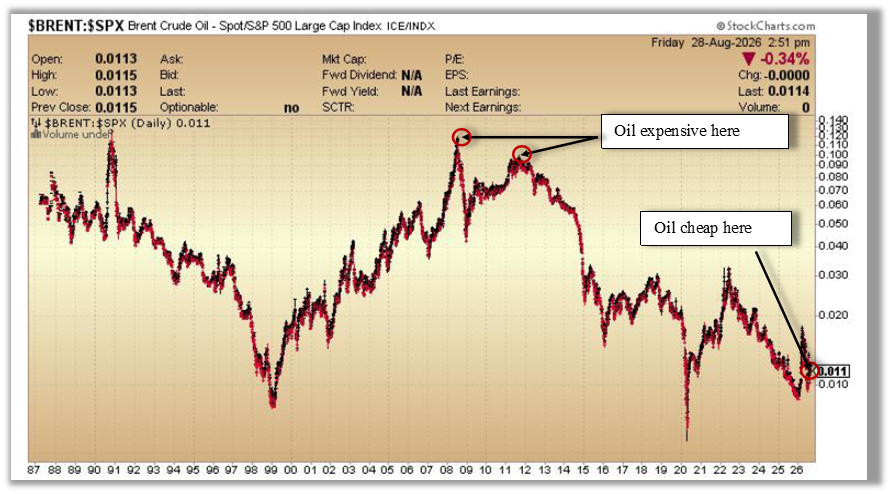
As the chart above shows, the price of oil relative to the price of the S&P 500 is still very low relative to their prices over the past 40 years.
To put that all together, you have a versatile commodity that is used in a wide variety of ways, the demand for which is still rising even as the primary uses for the commodity shifts over time, at a time when real assets like commodities in general and oil more specifically are cheap relative to financial assets like stocks.
If oil were only used for one thing – powering vehicles – and there was a movement away from using oil for that purpose, this would be a different story. However, there is no one substitute for crude oil. Despite the various motivations to move away from petroleum reliance, there is no current substitute for it in most of its uses, and even those substitutes that do exist have their own supply and demand considerations.
On January 10, 1976, Saturday Night Live featured a parody commercial where Dan Akryod and Gilda Radner argued whether or not the product “Shimmer” was a dessert topping or a floor wax. Chevy Chase stepped in to assure them that Shimmer was BOTH a dessert topping AND a floor wax. It seemed absurd at the time, but here we are with crude oil: an engine lubricant AND a lip balm. And an anesthetic, and a clothing fiber, and it heats your house, and you can color with it, and the list goes on and on. As of now, with financial assets like stocks seemingly over-priced, and commodities like oil in the beginning to middle innings of an upward valuation cycle, oil appears to be paying off for those who are considering its investment possibilities.
Editor’s Note: This article was originally published in the September 2026 edition of our Cadence Clips newsletter.
Important Disclosures
This blog is provided for informational purposes and is not to be considered investment advice or a solicitation to buy or sell securities. Cadence Wealth Management, LLC, a registered investment advisor, may only provide advice after entering into an advisory agreement and obtaining all relevant information from a client. The investment strategies mentioned here may not be suitable for everyone. Each investor needs to review an investment strategy for his or her own particular situation before making any investment decision.
Past performance is not indicative of future results. It is not possible to invest directly in an index. Index performance does not reflect charges and expenses and is not based on actual advisory client assets. Index performance does include the reinvestment of dividends and other distributions
The views expressed in the referenced materials are subject to change based on market and other conditions. These documents may contain certain statements that may be deemed forward‐looking statements. Please note that any such statements are not guarantees of any future performance and actual results or developments may differ materially from those projected. Any projections, market outlooks, or estimates are based upon certain assumptions and should not be construed as indicative of actual events that will occur. Data contained herein from third party providers is obtained from what are considered reliable sources. However, its accuracy, completeness or reliability cannot be guaranteed.
Examples provided are for illustrative purposes only and not intended to be reflective of results you can expect to achieve.